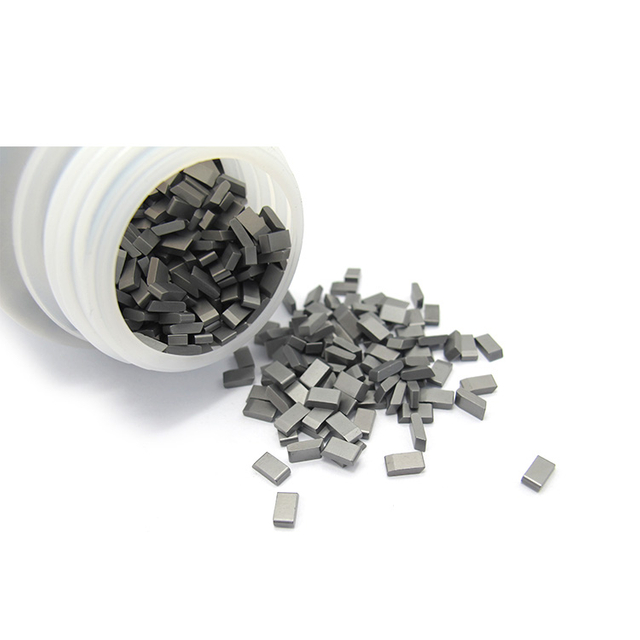
Metal ceramic blades are particularly suitable for processing stainless steel, mainly because stainless steel has several "difficult-to-handle" characteristics during cutting, and metal ceramics (Cermet) can precisely address these issues. The main reasons are as follows:
1. Not easy to stick to the blade (the most crucial reason)
One typical problem with stainless steel during cutting is "tool sticking" / "chatter marks".
Reason:
Stainless steel has high plasticity.
It is prone to stick to the cutting edge of the tool during cutting.
Formation of built-up edge
Consequences:
Surface is rough.
Tool chipping or breaking
Inconsistent dimensions
Metal ceramics mainly consist of TiC / TiCN / TiN. These materials:
Has a low chemical affinity with stainless steel
The surface friction coefficient is low.
Not easy to adhere to metals
Result:
The cutting is smoother and less likely to stick to the blade.
2. High temperature resistance capability
The cutting temperature during the processing of stainless steel is usually very high.
Reason:
Stainless steel has poor thermal conductivity.
The heat is concentrated at the cutting edge of the tool.
The problem with hard alloy:
The bonding phase (cobalt) is prone to soften at high temperatures.
The wear and tear is accelerating.
Advantages of Metal Ceramics:
Higher hardness at high temperatures
It maintains hardness at 800–1000°C.
Result:
The cutting tools wear out more slowly
3. Better surface quality
Characteristics of metal ceramic cutting tools:
The blade can be made extremely sharp.
Low friction coefficient
Cutting is more stable.
When processing stainless steel, the following issues may arise:
Less burrs
Less built-up edge wear
The surface is smoother.
So in many industries:
Fine grinding of stainless steel → Preferentially use metal ceramics
For example:
Axial parts
Valve parts
Medical parts
4. Strong anti-diffusion wear resistance
At high temperatures, elements in the cutting tool and the workpiece material will undergo diffusion.
Hard alloy:
Cobalt (Co) readily reacts with the elements in steel.
Resulting in rapid wear and tear of the cutting tools
TiC/TiCN in metal ceramics:
Higher chemical stability
Less diffusion wear
Result:
The tool lasts longer
Summarize in a single sentence:
The difficulties in processing stainless steel are:
Sticky blade + High temperature + Rapid wear and tear
And metal ceramics precisely possess:
Low adhesion
Resistant to high temperatures
High wear resistance
So in many cases of advanced processing: Metal ceramic blades > Hard alloy blades
Taking the construction group company as the development blueprint, Jingxin Group will focus on the development of cemented carbide, mining machinery, engineering tools, auto parts, new energy, and leisure sports equipment industries.

 +86-18073319589